Custom Menu Mistakes: What Goes Wrong on a First Order
The biggest custom menu mistakes on a first order are picking the wrong format for the room, choosing a stock that cannot handle the service, printing prices that will change and rushing the proof. Get Custom Menus catches most of these at the free mockup stage, but knowing them in advance means your menus are right the first time they reach a table.
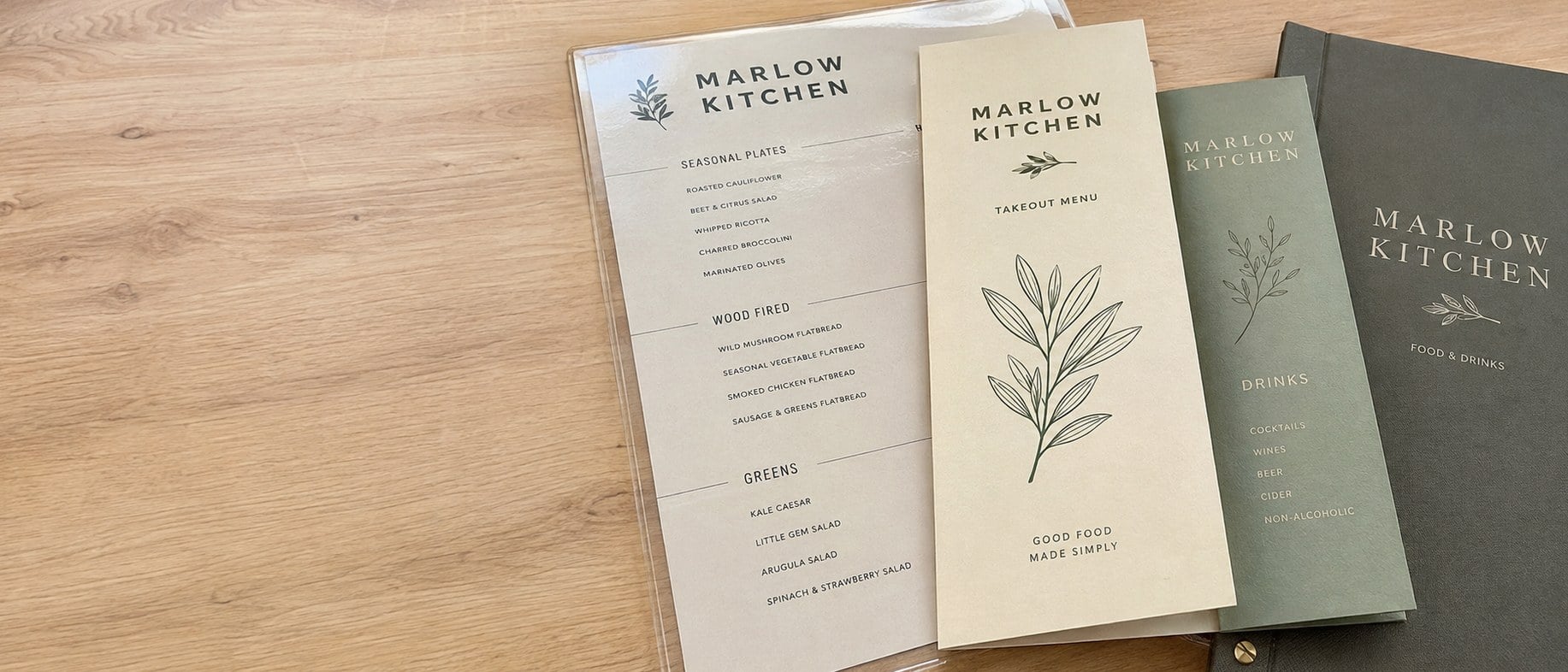
- Free mockup within 24 hours, unlimited free revisions
- Pay nothing until you approve the design
- Minimum order of 12 menus per design
- Standard turnaround about 2 weeks after proof approval
- Laminated, synthetic, booklet, paper and takeout formats in one order
What are the most common mistakes on a first custom menu order?
The most common mistakes on a first custom menu order are choosing a format that does not suit the room, picking a stock that cannot handle the service, and approving a proof without a proper check. Get Custom Menus sees the same handful of problems again and again, and almost all of them are avoidable before anything is printed, because production only starts once you approve the final design.
First orders go wrong for a simple reason: the menu is usually finished last, by someone who is also hiring staff, training the kitchen and chasing inspections. Decisions get made quickly, and small oversights become a box of menus nobody wants to hand to a guest.
| Mistake | What it costs you | How to avoid it |
|---|---|---|
| Wrong format for the service | Menus that feel awkward at the table or counter | Match the format to how guests order |
| Wrong stock for the room | Stained, curled or torn menus within weeks | Choose stock for spills, sun and handling |
| Printing prices that will move | A full reprint for a small change | Keep volatile items on a separate sheet |
| Rushing the proof | Typos and wrong prices in front of every guest | Check the proof line by line with a second reader |
| Type too small for the lighting | Guests squinting or asking servers to read aloud | Review the mockup in the real room |
| Forgetting the other menus | Drink and dessert menus that do not match | Plan every menu in the same order |
How do you avoid ordering the wrong menu format for your restaurant?
Avoid the wrong menu format by starting with how guests order, not with what looks good in a catalog. Table service suits laminated restaurant menus or booklet menus; a busy counter or event suits disposable paper menus; delivery and pickup need trifold takeout menus that fit in a bag.
The classic first-order mistake is a long booklet in a fast casual room where guests order at the register and never sit with a menu in hand. The opposite happens too: a single paper sheet in a fine-dining room where guests expect something with weight that matches the price of the meal.
Ask yourself three questions before you choose:
- Where does the guest hold the menu? At a table, at the bar, in a queue or at home.
- How long does the guest keep it? A few seconds, a full meal, or on the fridge for months.
- How often will the content change? Rarely, seasonally, or every week.
If the answers differ by area of the business, that is a sign you need more than one format, which Get Custom Menus can produce in a single order.
Which menu stock mistakes cause menus to wear out early?
Menus wear out early when the stock does not match the abuse they take. Plain paper in a room with sticky tables, wet glasses or a patio breeze will curl, stain and tear long before the season ends, while a heavy laminated menu at a quick counter is more than the job needs.
Think honestly about the conditions your menus will face. A brunch room with syrup and coffee rings, a pub with spilled beer, a pool deck with wet hands and sunscreen, a kids’ area with crayons: each of these punishes the wrong stock. Waterproof synthetic menus are built for the wettest rooms, laminated menus wipe clean between tables, and disposable paper menus avoid the problem entirely by being replaced instead of cleaned.
The other stock mistake is mixing formats without a plan. A dining room with laminated mains and a flimsy paper drinks list looks inconsistent. If you need both, keep the branding identical so the paper piece reads as a deliberate insert, not an afterthought. Our guide to disposable paper vs laminated menus walks through the trade-offs side by side.
Why is printing every price on a permanent menu a mistake?
Printing every price on a long-lasting menu is a mistake when your costs or dishes move often, because a single price change forces a full reprint. Restaurants with volatile ingredients, seasonal specials or a rotating draft list should keep those items off the permanent menu and on a sheet that is cheap and quick to replace.
The pattern that works for most rooms is a core menu for the dishes that rarely change, printed on a durable stock, plus a specials or market sheet for everything that moves. Bars do the same with a fixed cocktail list and a separate card for rotating taps or seasonal drinks, which suits drink and cocktail menus well.
A few habits keep reprints rare:
- Group the dishes most likely to change in one section that can move to an insert later.
- Avoid printing dates, seasons or limited-time wording on a menu meant to last all year.
- Keep your approved file so the next version is a quick edit, not a redesign.
Get Custom Menus keeps revisions unlimited and free, so updating a design for a reprint costs you time on the proof, not a fresh start.
What should you check on a custom menu proof before approving it?
Check every price, every dish name and every piece of contact information on a custom menu proof, and have a second person read it who did not write the text. The proof is the last moment a fix is free; once you approve it, production starts and every guest sees whatever is on the page.
Most proof mistakes are not design problems. They are a price copied from an old spreadsheet, a dish the kitchen dropped last week, a misspelled supplier or wine name, or a phone number with two digits swapped. Owners miss them because they have read the text so many times that the eye fills in what should be there.
A practical proof routine:
- Read prices against the point-of-sale system, not against your draft document.
- Ask the chef to read the dish names and descriptions for anything that changed.
- Check dietary and allergen symbols against the kitchen’s current recipes.
- Confirm the address, hours, website and social handles on every panel.
- Read the proof out loud once; spoken errors are easier to hear than to see.
Get Custom Menus sends a free mockup within 24 hours, and you pay nothing until you approve the design, so taking an extra day to check costs nothing.
How do you know if the text on your menu is too small to read?
Menu text is too small when a guest has to tilt the menu toward a candle or hold it at arm’s length to read it. The only reliable test is to print the mockup at actual size and read it in your own room, at your own lighting level, during an evening service.
Dim dining rooms, candlelit tables and dark bars are where this mistake shows up. A layout that looks elegant on a bright laptop screen can turn unreadable once the lights drop, especially thin script fonts, light gray type on cream paper or dish descriptions squeezed into a narrow column.
When the mockup arrives, try this:
- Read the descriptions at a table in your darkest corner.
- Ask an older regular or staff member to read a few lines without glasses help.
- Check that prices are easy to find beside each dish without hunting.
- Look for dark-on-dark or light-on-light combinations that disappear in low light.
If anything is hard to read, ask for larger type, stronger contrast or fewer words per item. The fix is usually to cut description length, not to shrink the type further.
Is it a mistake to fit every dish onto one menu?
Fitting every dish onto one menu is usually a mistake, because crowded pages slow guests down and make it harder to notice the dishes you most want to sell. A menu with clear sections and breathing room reads faster, looks more confident and is easier to update than a page packed edge to edge.
First-time owners often try to show everything the kitchen can make, plus every drink, every side and every add-on. The result is small type, cramped columns and guests who default to the first familiar dish they see. Splitting the content into a main menu, a drink menu and a dessert card often solves the problem better than a bigger format.
Why should every menu in your restaurant be planned in the same order?
Plan every menu in the same order so the food menu, drink list, dessert card, kids’ menu and takeout menu share one design and arrive together. Ordering them piecemeal is a common first-order mistake that leaves a restaurant with mismatched fonts, colors and logos on the same table.
The drink list is the usual casualty. Owners order the main menus first, then realize at the soft opening that the bar is still using a printed spreadsheet. Takeout menus come next, often designed separately and looking nothing like the dining room. Each later order also restarts the proof and production cycle, which costs time you may not have.
Make a list of every place a guest reads your offer: tables, bar, patio, counter, delivery bag, front window. Then decide which format each one needs and include all of them in one brief. Get Custom Menus can combine laminated, booklet, paper and takeout formats in a single order, with a minimum of 12 per design, so the smaller pieces do not need a separate project.
What timing and quantity mistakes catch first-time buyers out?
The timing mistake is ordering menus as the last task before opening, and the quantity mistake is ordering exactly enough with no spares. Both leave you exposed: a late order shrinks the time you have to check the proof, and a count with no buffer leaves you short the first time a menu is damaged or walks out the door.
Standard turnaround at Get Custom Menus is about 2 weeks after you approve the proof, with faster turnaround available with express shipping. Building that into your schedule, plus a day or two for the mockup and revisions, keeps the proof check calm instead of rushed. Our guide on when to order custom menus plans that backward from launch day.
On quantity, count seats, bar stools and patio tables, then add spares for damage and busy nights. For menus that change often, order fewer and reorder more often rather than stockpiling a version that will be out of date. The quantity planning guide covers the counting in detail.
How does Get Custom Menus help you avoid these mistakes?
Get Custom Menus builds the safeguards into the process: you get a free mockup within 24 hours, unlimited free revisions and you pay nothing until you approve the design. That gives you room to test the format, check the proof and fix problems before a single menu is printed.
- Send a quote request with your menu text, logo and the formats you need.
- Review the mockup in your own room and lighting, and request changes.
- Run your proof check with a second reader before you approve.
- Approve and receive your menus in about 2 weeks.
Ready to start? Request a custom menu quote or read how it works first.
Frequently asked questions
What is the most common mistake restaurants make on a first custom menu order?
The most common mistake on a first custom menu order is approving the proof too quickly. Owners read text they wrote themselves and miss a wrong price, a dropped dish or a swapped phone digit. Get Custom Menus sends a free mockup within 24 hours and nothing prints until you approve, so ask a second person to check every line against your point-of-sale system first.
Can I fix a typo after my custom menus have been printed?
Custom menus cannot be corrected once printed, so a typo on the final run means living with it, covering it or reprinting. The safer route is catching errors at the proof stage, where changes are free and unlimited. If a mistake does slip through, keep your approved file so the corrected reprint is a quick edit rather than a new design.
Can I order a small trial run of custom menus before committing to a full order?
Custom menus can be ordered in small runs, with a minimum of 12 per design at Get Custom Menus. A short first run is a sensible way to test a new format, stock or layout during real service before ordering for every table. Watch how guests handle the menus, how they clean up and whether the text reads well in your lighting.
Why do the colors on my printed menu look different from my screen?
Printed menus often look slightly different from a screen because monitors glow with light while paper reflects it, and every screen is calibrated differently. Bright neon tones and very dark shades shift the most. Share your exact brand colors with the designer, and judge the mockup knowing that the printed result will look a touch more muted than a backlit display.
Will a low-resolution logo cause problems on printed menus?
Printed menus show every flaw in a low-resolution logo, which can look blurry, jagged or pixelated once it is reproduced at full size. A logo copied from a website or social profile is often too small. Send the original vector or high-resolution file if you have one, and Get Custom Menus will flag the issue on the mockup if the logo will not print cleanly.
Should I add food photos to my custom menus?
Food photos on custom menus work only when the photography is sharp, well lit and accurate to what the kitchen actually serves. Phone snapshots taken under warm kitchen lights tend to look dull in print and can make dishes less appealing. Many restaurants use a few strong images or none at all, letting clear descriptions and good layout do the selling instead.
What contact details are worth printing on a dine-in menu?
Dine-in menus usually need only the restaurant name, website and social handles, plus a phone number if you take reservations or offer catering. Opening hours are risky on a long-lasting menu because they change. Takeout menus should carry the phone number, address and ordering details prominently, since guests keep them at home and use them to place orders later.
Do my food, drink and dessert menus need to share the same design?
Food, drink and dessert menus do not need to be identical, but they should clearly belong to the same restaurant through shared fonts, colors and logo placement. Mismatched menus on one table make a room feel unfinished. Get Custom Menus can design every piece in one brief, so a cocktail list or dessert card can use a different format while keeping a consistent look.
How long should the dish descriptions be on a restaurant menu?
Restaurant menu descriptions work best when they are short enough to scan, usually a line or two naming the key ingredients and cooking method. Long paragraphs force smaller type and crowd the page. If a dish needs a story, let servers tell it at the table, and keep the printed menu focused on helping guests decide quickly and confidently.
Is it a mistake to choose a menu stock based only on looks?
Choosing menu stock on looks alone is a frequent mistake, because the prettiest paper is not always the one that survives your room. Think about spills, wiping, sunlight and how often menus are handled before you decide. Get Custom Menus offers laminated, waterproof synthetic, booklet and disposable paper options, so you can match durability to the service rather than guess.
What should I send so my first custom menu mockup is right the first time?
A first custom menu mockup comes closest to final when you send the complete menu text, current prices, your logo file, brand colors and a note on where each menu will be used. Mark any dishes that are still placeholders. Get Custom Menus returns the mockup within 24 hours, and the clearer the brief, the fewer revision rounds you will need.
Get a free mockup for your menus
Send your logo or idea and the quantity you have in mind. Get Custom Menus returns a free mockup within 24 hours, you approve the design before anything is produced, and standard turnaround is about two weeks with faster options available. Get a custom quote.
Win Free Stuff
Enter below for a chance to win plus receive 10% off your first order.
🎉 You are in!
We will text you your 10% off code. Good luck!