A menu’s size is not a cosmetic choice. It decides how much you can list without crowding, how the menu feels in a guest’s hands, how often you can afford to reprint, and whether the thing survives a spilled glass of red. Restaurants tend to default to whatever the printer assumes and discover the consequences later. This guide walks the common formats and stocks in the order that actually matters, from the workhorse letter size to the folded formats, the supporting inserts, and the paper and lamination that determine how long any of it lasts.
The default, and when to leave it
Letter size, 8.5 by 11 inches, is the size a printer assumes if you say nothing, and for good reason. It holds a full food menu for most restaurants, fits standard sleeves and boards, and photographs cleanly. If your list is average in length and you want one predictable, easy-to-source format, this is it.
The moment your menu starts to feel cramped, the next step up is legal size at 8.5 by 14 inches. That extra three inches of height buys room for another section or more breathing space around each item without forcing you into a fold. Legal is the honest answer for a restaurant with a long single-page list that does not want the complication of panels, though you should confirm your menu covers and sleeves accommodate the taller sheet before you commit.
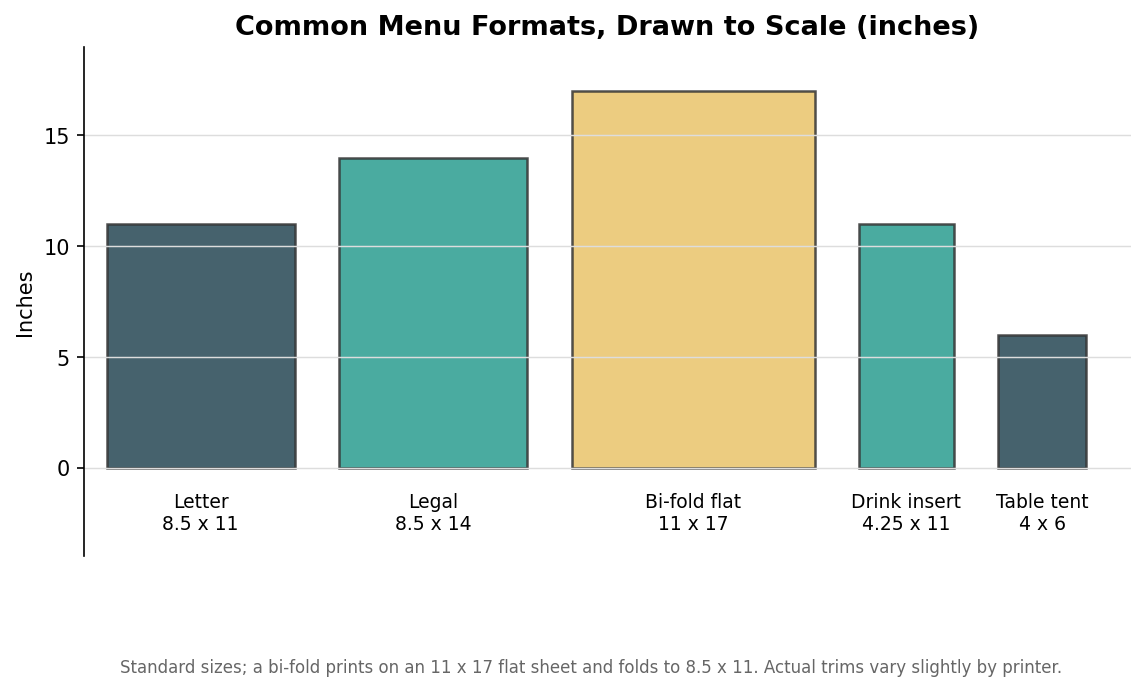
The diagram above shows the common formats drawn to the same scale, which makes the real differences obvious in a way a spec sheet does not. A table tent is genuinely small; a bi-fold’s flat sheet is genuinely large. Seeing them together is the fastest way to feel which one suits your table and your list.
Folded menus: bi-fold and tri-fold
When a single sheet will not hold everything, folding multiplies your space without enlarging the footprint on the table. A bi-fold menu prints on an 11 by 17 flat sheet and folds down to 8.5 by 11, giving you four panels in a familiar closed size. It reads like a slim booklet and suits menus that want a cover, an inside spread for food, and a back panel for drinks or the story of the place.
A tri-fold works differently and trips up more people. It prints on a standard 8.5 by 11 sheet folded into three panels, but the panels are not all the same width: the panel that tucks inside is cut slightly narrower, often around three and two-thirds inches, so the menu closes flat instead of bulging. Design each panel as its own page, keep critical content off the fold lines, and remember that the inner panel has a hair less room than the others. Tri-folds shine for takeout menus and compact drink lists where you want structure without bulk.
The supporting cast: inserts and table tents
Not everything belongs on the main menu, and forcing it there is how menus get reprinted every time a wine changes. A drink or dessert insert at 4.25 by 11 inches is a slim card that slips inside or alongside the main menu, letting you swap beverages and specials on a cheaper, faster reprint while the expensive food menu stays put. This one decision often pays for itself within a season.
Table tents, commonly 4 by 6 inches, do the promotional work: a featured cocktail, a dessert of the week, a happy-hour window. They stand on the table, cost little, and change often, which is exactly what you want for anything time-sensitive. Treating specials as table tents rather than menu lines keeps your core menu stable and your promotions nimble.
Stock: weight is the feel, lamination is the lifespan
Two separate decisions govern how a menu holds up. The first is paper weight. A thin text weight around 70 pounds feels flimsy in the hand, while 100-pound cardstock and heavier reads as substantial and resists curling. Heavier cover stocks, often specified in points such as 14 or 16 point, feel like a premium menu the moment a guest picks it up. Weight is largely about perceived quality and rigidity, and it is worth spending on for a menu guests handle at every visit.
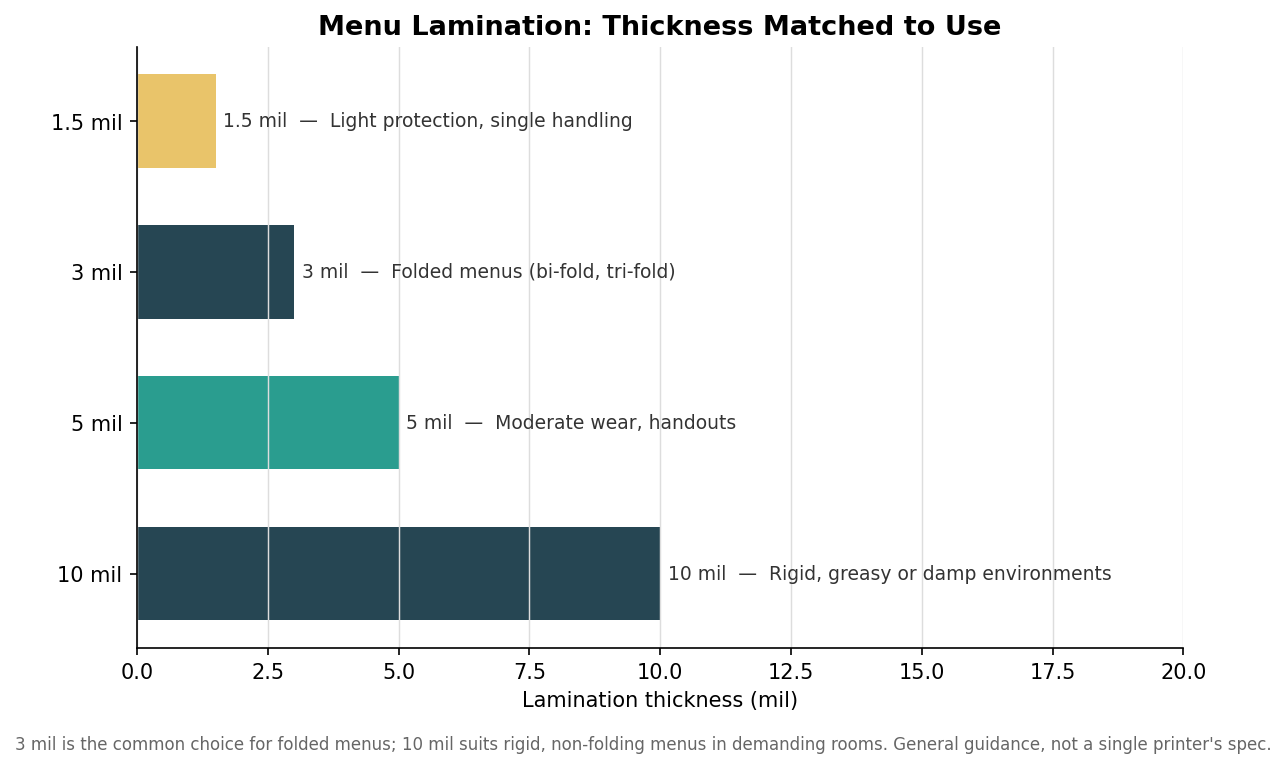
The second decision is lamination, which is what actually determines lifespan in a working dining room. As the chart shows, 3 mil is the common choice for menus that need to fold, thin enough to crease cleanly on a bi-fold or tri-fold. Step up to 10 mil for rigid, non-folding menus in greasy, damp, or high-traffic rooms where a menu takes real abuse. Lighter 1.5 mil suits menus you expect to reprint often, since paying for heavy protection on a menu you will replace in a month is money left on the table. Match the mil to how the menu lives, not to a vague sense that thicker is better.
Putting it together by service style
The right combination follows the room. A fine-dining restaurant with a curated list is well served by a single heavy letter or legal sheet on premium cover stock, lightly laminated or not at all, refreshed as the menu evolves. A fast-casual or family spot that hands the same menu to hundreds of guests a day wants a durable bi-fold or a rigid single sheet at 10 mil that shrugs off fingerprints and cleans with a wipe. A bar living on changing specials leans on a stable core menu plus 4.25 by 11 inserts and 4 by 6 table tents for anything that moves.
Decide in that order, use to format to stock to lamination, and the menu fits your list, feels right in the hand, survives the room, and costs the right amount to keep current. The size that seemed like a throwaway choice turns out to shape the whole economics of keeping a menu on the table.